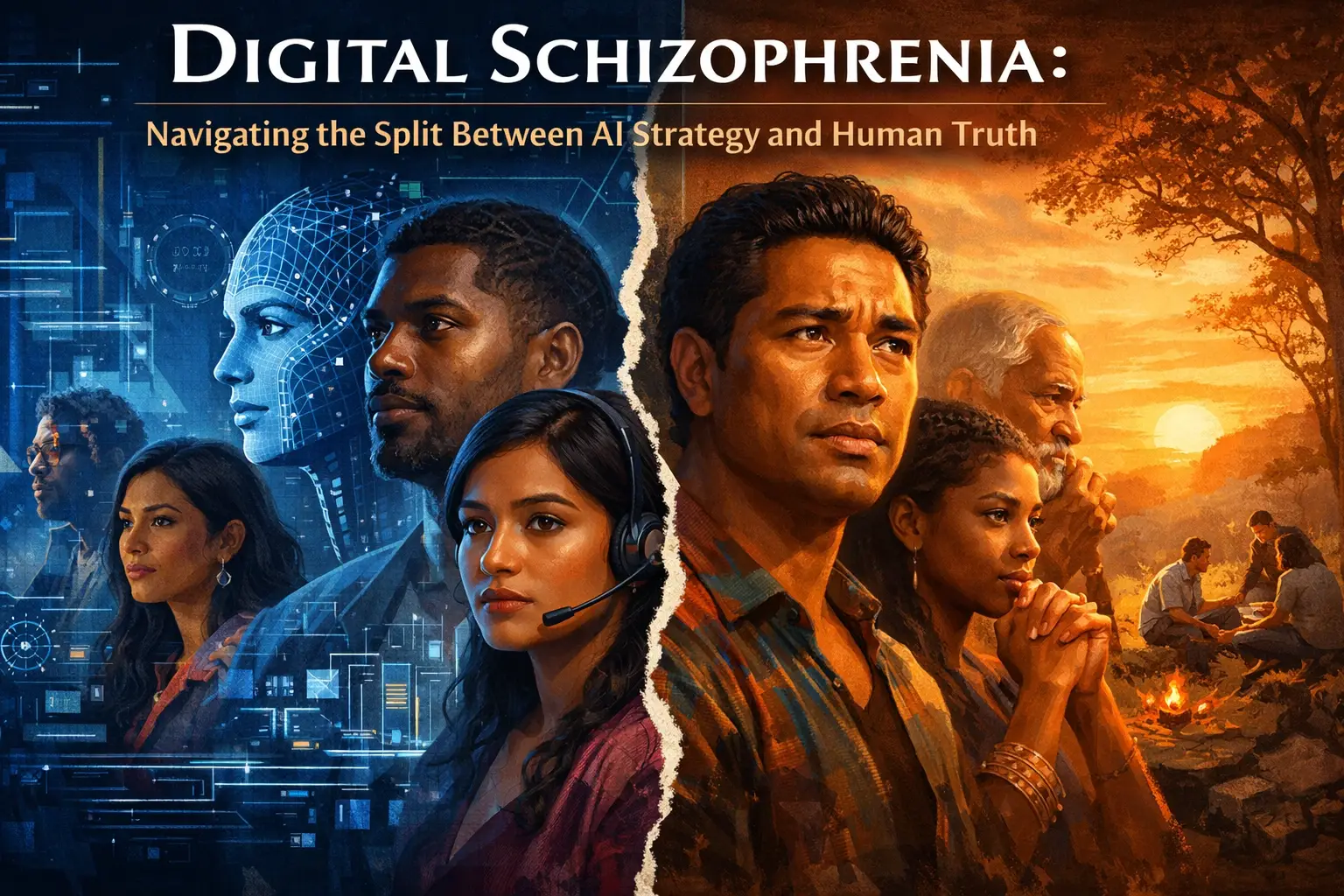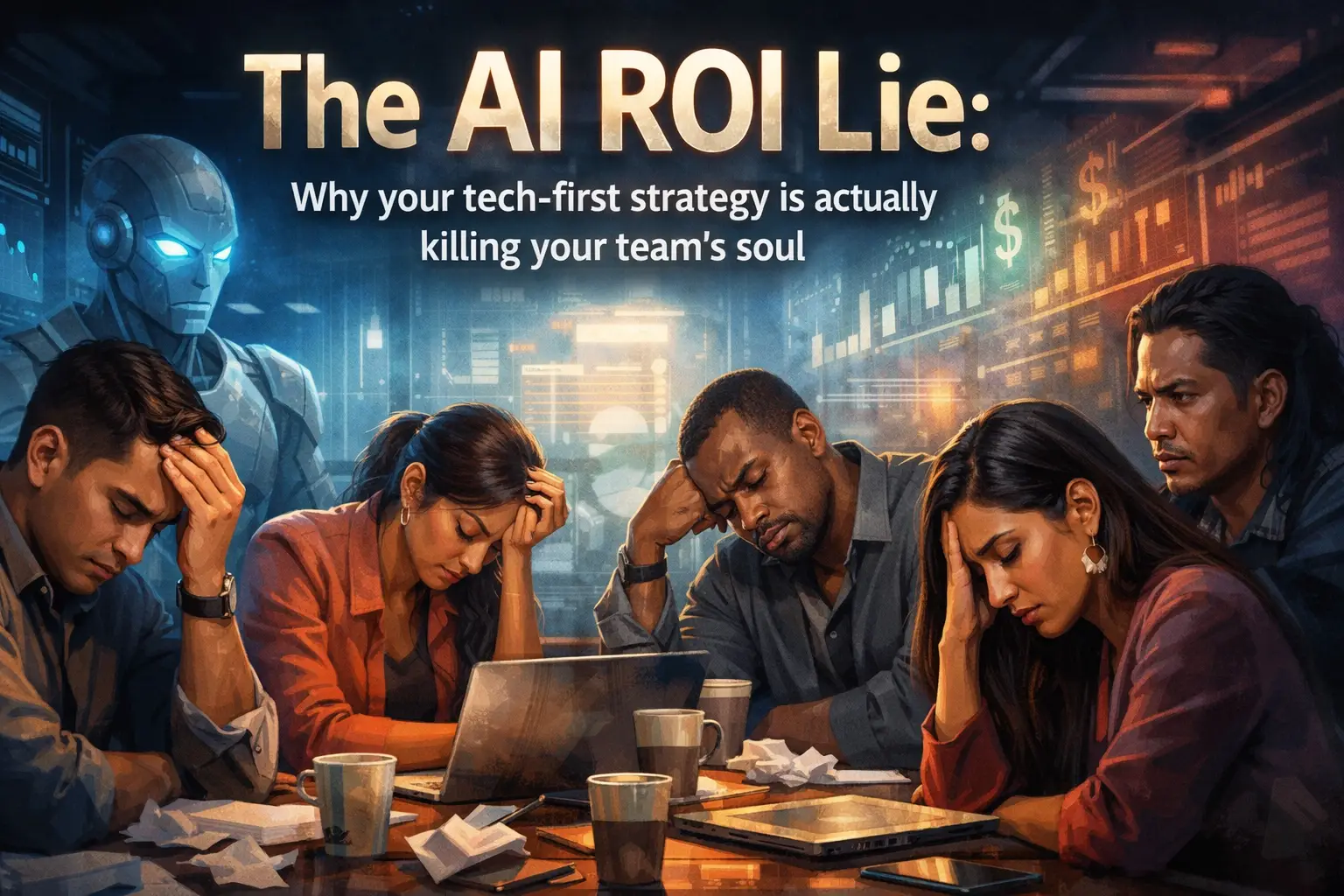
Let me be blunt: You're asking the wrong question.
While you're obsessing over AI ROI metrics in your quarterly board deck, your best people are quietly burning out. They're watching you chase algorithms while their concerns about workload, purpose, and meaning get relegated to "later" – that mythical time after the transformation pays off.
Here's the uncomfortable truth: 95% of organizations aren't realizing ROI from their AI investments, despite throwing $30-40 billion annually at the problem. But that's not even the real issue. The real issue is what you're sacrificing to chase those returns.
The Numbers Tell Half the Story
The research is sobering. Most companies take two to four years to see AI ROI – not the seven to 12 months they're used to with traditional tech investments. Only 6% see returns within a year. Internal AI builds fail twice as often as proven solutions. Organizations rush to deploy content generation tools because they seem like quick wins, only to discover they're actually "one of the riskiest and most challenging AI applications."

These are real problems. But here's what the MIT reports and consulting white papers won't tell you: While you're waiting for those returns to materialize, your team is hemorrhaging trust, energy, and soul.
What's Really Happening While You Chase the Algorithm
You call it "digital transformation." Your team calls it Tuesday.
Another tool to learn. Another process to adapt to. Another meeting about "AI strategy" where no one mentions that Sarah in Operations is working 60-hour weeks trying to clean data that should have been addressed five years ago. Or that your middle managers are having identity crises because they can't figure out what their role is supposed to be when the algorithm can do half their job.
The tech-first approach isn't just inefficient – it's existentially exhausting. You're asking people to redesign their entire relationship with work while simultaneously delivering the same results (or better, because isn't that the point of AI?) on the same timelines, with the same resources.
And then you wonder why engagement scores are tanking.
The Hidden Tax No One's Calculating
Here's what doesn't show up in your ROI calculations:
The cognitive load tax. Your team is learning new systems while maintaining old ones. They're being told to "experiment and fail fast" while also being measured on efficiency metrics that punish any dip in productivity. The mental whiplash alone is enough to break people.
The identity erosion tax. When you lead with technology and talk about people as "resources to be optimized," you're implicitly sending a message: Your value is measured by what the algorithm can't do yet. That "yet" hangs over everything like a sword of Damocles.

The trust deficit tax. Every time you prioritize the tech roadmap over having honest conversations about how people are actually coping, you widen the gap between leadership and reality. Your people stop telling you what's really going on. They perform "AI enthusiasm" in meetings while privately updating their LinkedIn profiles.
The soul fragmentation tax. This is the big one. When work becomes entirely about efficiency, optimization, and measurable outputs, something essential dies. The spark. The meaning. The sense that what we're building together matters beyond the quarterly numbers.
You can't put this in a spreadsheet, but you can feel it. Your best people start going through the motions. They're present but not really there. They've learned to delegate their engagement to autopilot while their actual selves check out.
The Inconvenient Truth About What Actually Works
Remember that research about successful organizations? They adopt "integrated, end-to-end approaches" and achieve "CEO-led, organization-wide prioritization." Sounds great in a consultant's PowerPoint.
But here's what that actually means when translated into human terms: The leader has to show up as a whole person, not just a strategy executor.
The companies seeing real results – including the non-financial returns like "improved employee satisfaction" – aren't treating AI as a tech problem. They're treating it as a human integration challenge. They're having uncomfortable conversations about what matters, what doesn't, and who gets to decide.

They're acknowledging that not all ROI is financial because they've done the harder work of defining what success actually means beyond the balance sheet. They've created space for their teams to grieve what's being lost in the transformation, not just celebrate what's being gained.
This is where most executives tap out. Because this work is messy. It requires you to slow down when everything in your training screams "move faster." It requires admitting you don't have all the answers. It requires being willing to look at the gap between your stated values and your actual priorities.
A Different Question Entirely
What if the real lie isn't about AI ROI at all?
What if the lie is believing that you can transform your organization without transforming yourself first? That you can lead people through massive technological and cultural change while staying safely in your own comfort zone, hidden behind strategy documents and implementation timelines?
The soul-led approach isn't about being soft or sacrificing results. It's about recognizing that sustainable transformation happens at the speed of trust, not at the speed of technology deployment.
It means asking different questions:
- What am I asking my team to sacrifice, and is it worth it?
- How am I showing up as a leader during this transition – am I modeling the integration I'm demanding?
- What parts of our humanity are we trying to optimize away, and what are we losing in the process?
- Am I creating space for grief, confusion, and resistance, or am I just expecting everyone to "get on board"?

These questions don't have easy answers. They don't fit neatly into your project plan. But they're the questions that determine whether your AI transformation builds something lasting or just burns through your best people on the way to mediocre results.
The Choice You're Actually Making
Here's the bottom line: You're going to invest in AI. The technology isn't going away, and neither is the competitive pressure to adopt it. The question is whether you're going to lead this transformation in a way that honors the full humanity of your team, or whether you're going to optimize them right out of caring.
The irony is that the soul-led approach – the one that feels slower and messier – is actually what gets you to meaningful ROI faster. Because when your team trusts that they're not just resources to be deployed, they bring their full creativity, resilience, and intelligence to solving the actual problems. They don't just implement your AI strategy; they make it better.
But this requires you to do something most executives resist: Get uncomfortable first. Question your own assumptions about what leadership looks like. Examine where you're hiding behind the technology to avoid harder human conversations. Be willing to measure success in ways that don't show up in the quarterly report.
Your team's soul isn't a nice-to-have that you'll get back to after the transformation. It's the thing that determines whether your transformation actually transforms anything – or just adds expensive tools to broken processes while burning through the people you can't afford to lose.
The tech-first strategy isn't just killing your team's soul. It's killing your competitive advantage, one disengaged high-performer at a time.
The question is: What are you going to do about it?