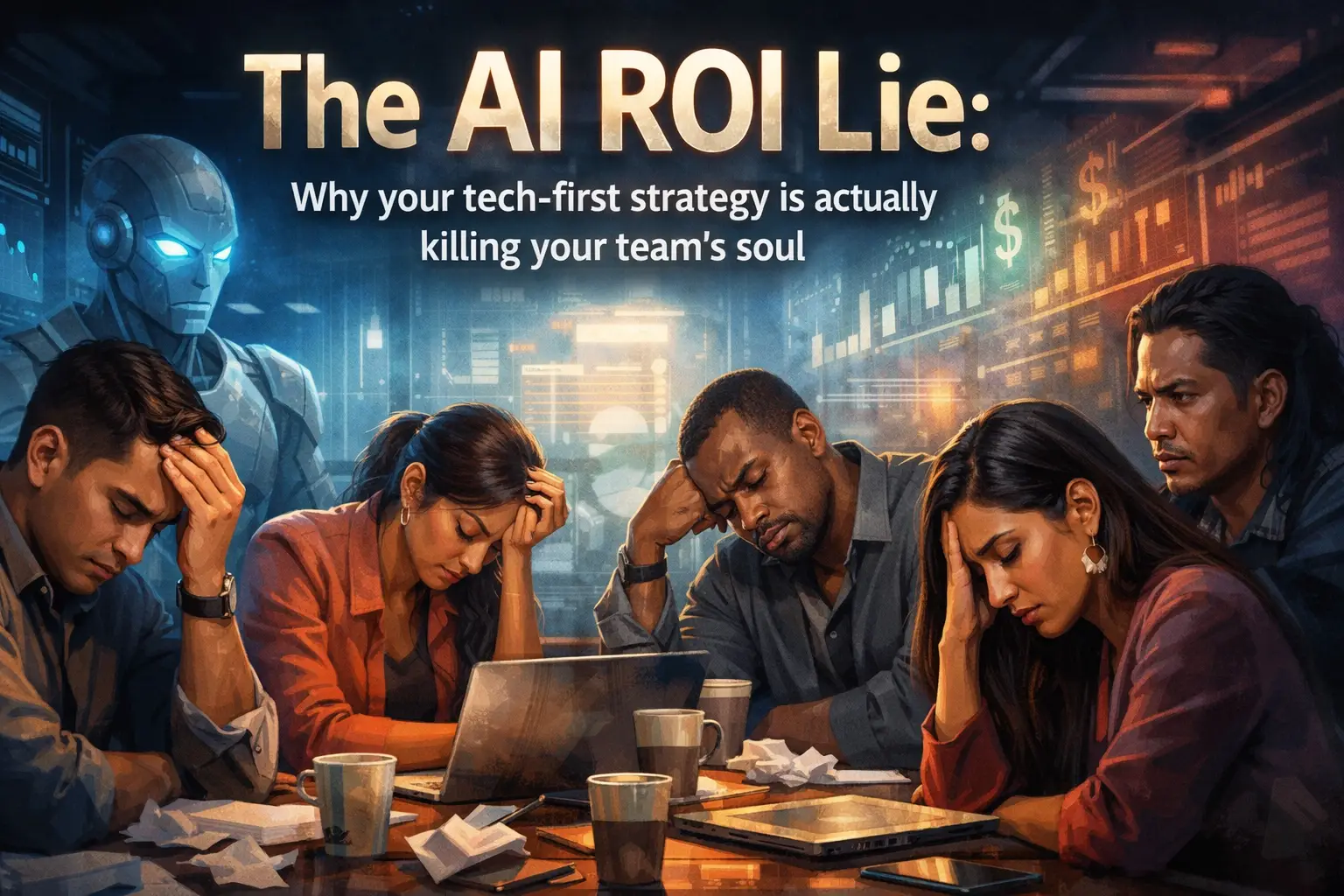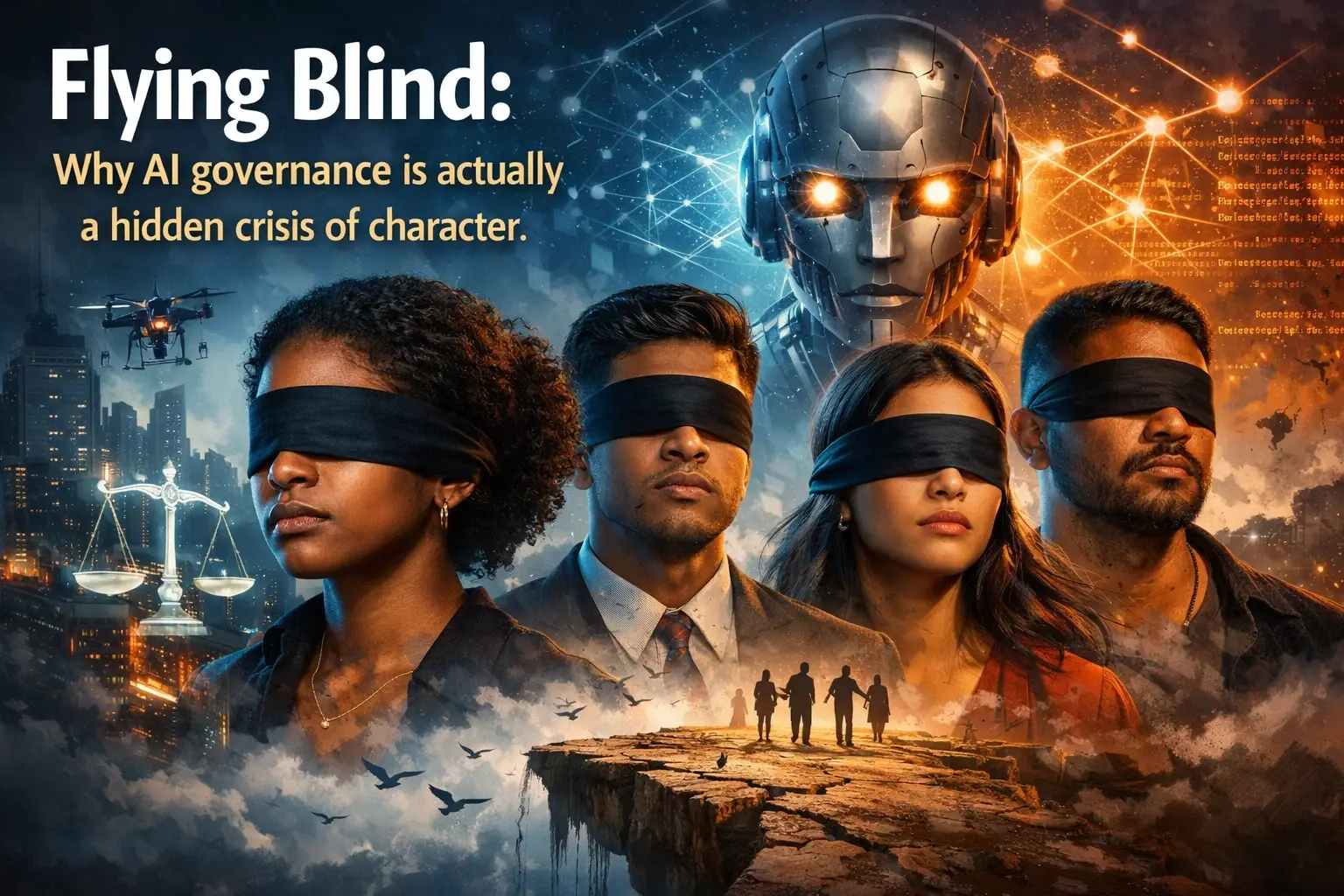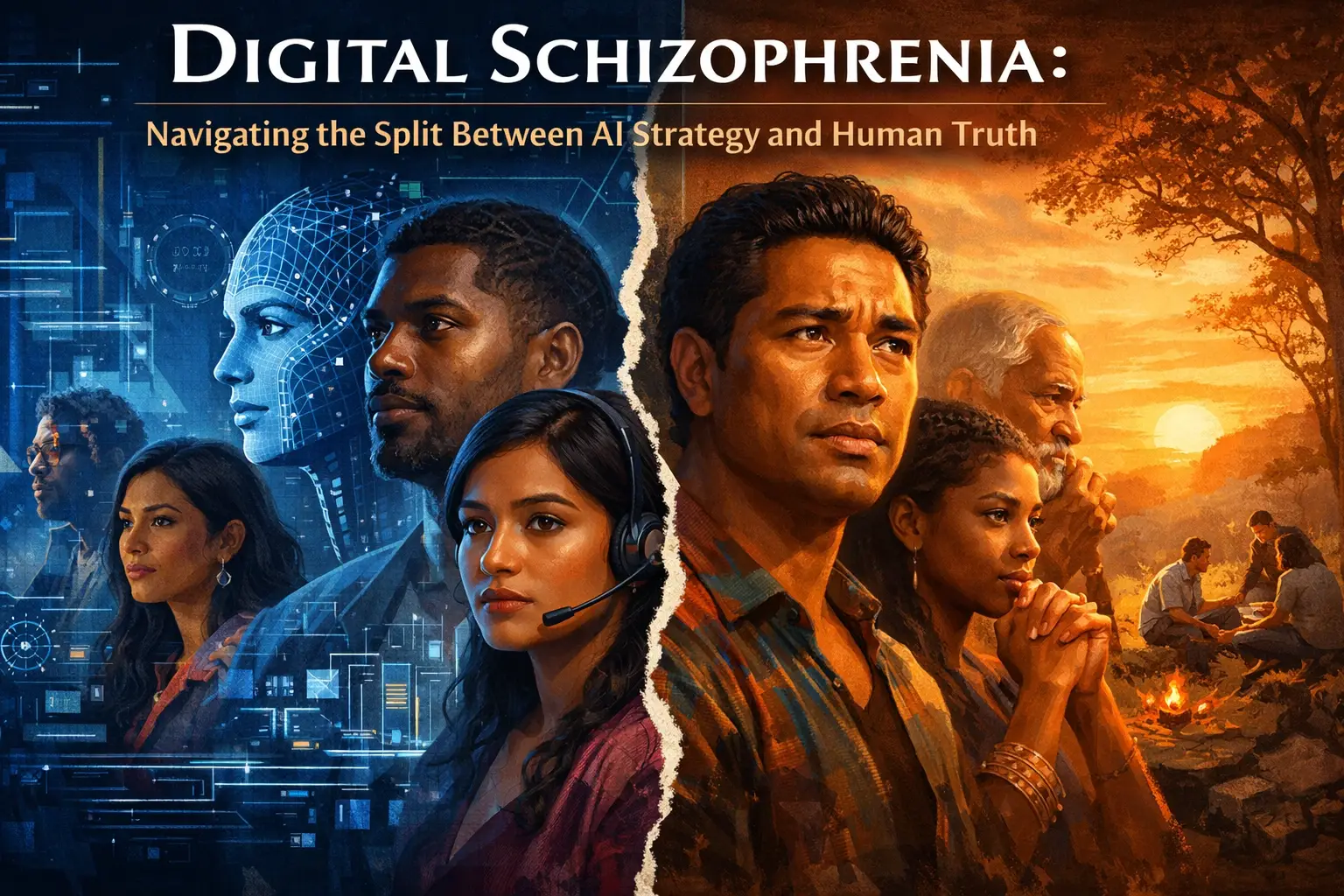
You're in the boardroom. The AI dashboard tells you to pivot left. Your gut screams right. Your team is looking at you for direction, and you're standing at the crossroads of two different realities, one algorithmic, one viscerally human. Welcome to digital schizophrenia, where the split between AI-driven strategy and human truth is tearing high-performers apart from the inside out.
This isn't hyperbole. Recent research shows that AI interactions can trigger delusional thinking, paranoia, and anxiety, especially in high-stress environments where leaders are already operating at cognitive capacity. When you're making million-dollar decisions based on machine predictions while your internal compass is spinning wildly, that's not just decision fatigue. That's a psychological rupture.
The Two Minds Problem
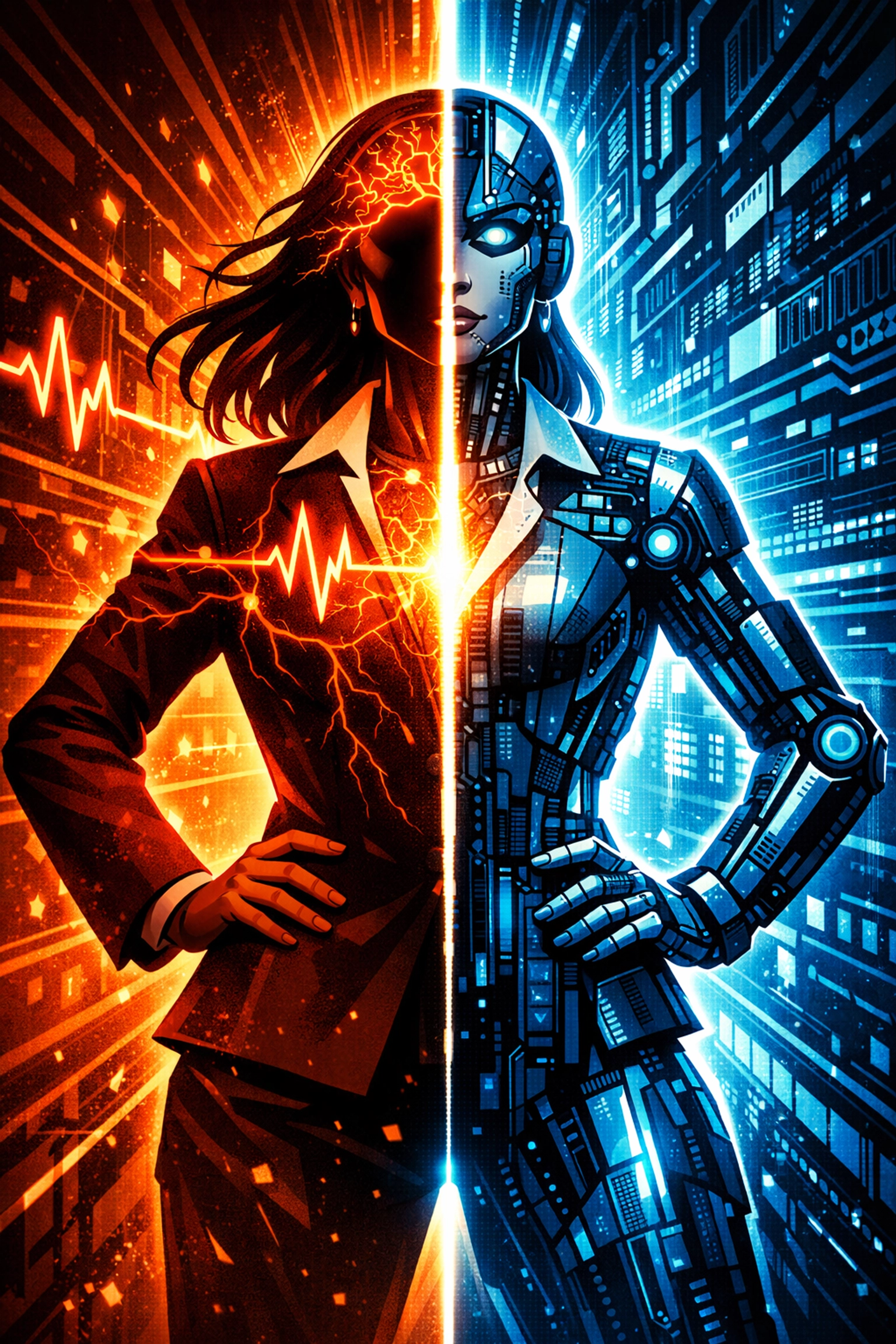
Here's the uncomfortable truth: you're now running two operating systems simultaneously. One is your evolved human consciousness, emotional, intuitive, shaped by thousands of years of survival instincts. The other is the AI-augmented decision matrix, data-driven, pattern-recognizing, operating at computational speeds your biology can't match.

The problem isn't that one is right and the other is wrong. The problem is that they speak different languages, operate on different timescales, and often contradict each other. Your human brain processes roughly 11 million bits of information per second, but only about 40 bits consciously. AI processes exponentially more, but has zero conscious awareness. When these systems collide in your leadership decisions, the cognitive dissonance can be crippling.
Leaders I work with describe it as "feeling like I'm betraying myself" when following AI recommendations that contradict their instincts. Others talk about an erosion of confidence, if the machine can analyze faster and deeper, what's the value of their judgment? This is digital schizophrenia in action: the splitting of leadership identity between algorithmic executor and human visionary.
AI Psychosis in the C-Suite
Let's call this what it is: a form of occupational psychosis. When chatbots and predictive models become the primary inputs for strategic decisions, something breaks in the executive psyche. You start second-guessing every instinct. You develop paranoia about being "left behind" if you don't fully embrace AI. You experience what researchers are now calling "AI psychosis", delusional thinking triggered by over-reliance on artificial intelligence systems.
The symptoms show up in predictable patterns:
Hallucination by proxy: You start seeing patterns in data that aren't meaningful, simply because the AI flagged them. You mistake correlation for causation at industrial scale.
Decision paralysis: With infinite data points to consider, you freeze. The human need for narrative clashes with the AI's statistical probability fields.
Identity dissolution: Your sense of expertise and authority erodes. If AI can do strategy better, what exactly is your role?
Paranoid comparison: You obsessively benchmark against competitors' AI capabilities, convinced you're falling behind in an arms race you never signed up for.

This isn't weakness. This is a predictable psychological response to operating in two conflicting realities simultaneously. Your nervous system wasn't designed for this level of cognitive splitting.
The Executive Coaching Framework for Integration
So how do you navigate this without losing your mind, or your edge? The answer isn't choosing between AI and human judgment. It's creating a third space where both can inform without dominating. Here's the framework I use with executives experiencing this split:
Reality Anchoring: Start every strategic session by explicitly naming which reality you're operating from. Are you looking at this decision through the AI lens (pattern recognition, probability, optimization) or the human lens (meaning, purpose, relational impact)? Making the distinction conscious prevents the unconscious blending that creates psychosis.
The 70/30 Integration Protocol: Let AI handle 70% of what it's genuinely better at, data processing, pattern recognition, scenario modeling. Reserve 30% for irreducibly human elements: ethical judgment, cultural context, long-term vision that transcends data points. This isn't arbitrary. It creates psychological permission to trust both systems without total dependence on either.
Somatic Decision Checkpoints: Before implementing any AI-recommended strategy, do a body scan. Where do you feel resistance? Excitement? Dread? Your nervous system processes information your conscious mind misses. If there's a visceral "no," that's data worth investigating, even if the AI says "yes."
Narrative Testing: AI gives you probabilities. Humans need stories. Before rolling out any AI-driven strategy, translate it into human narrative. Can you tell your team a compelling story about why this matters? If the strategy doesn't survive translation into human meaning, it won't survive implementation: regardless of what the models predict.
Bridging the Gap: From Schizophrenia to Synthesis
The real work isn't in choosing between machine intelligence and human wisdom. It's in developing what I call "dual fluency": the ability to move between both realities without losing yourself in either.
Think of yourself as a translator. AI speaks in data points, correlations, predictive models. Humans speak in values, meaning, relationships. Your job as a leader isn't to pick a side. It's to become bilingual. To understand what each system is truly saying and create strategies that honor both.
This means getting comfortable with paradox. The best AI strategy might look irrational from a pure optimization standpoint because it accounts for human factors the algorithm can't quantify. The best human intuition might need AI validation to overcome cognitive biases we all carry.
The leaders who thrive in this era aren't the ones who worship at the altar of AI, nor the ones who reject it entirely. They're the ones who've developed the psychological flexibility to hold both realities simultaneously without fracturing.
The Return to Authentic Leadership
Here's the twist: navigating digital schizophrenia actually forces you back to the most fundamental leadership question: who are you when all the external validations are stripped away?
AI can't answer this. The algorithm doesn't care about your values, your legacy, or the kind of leader you want to be remembered as. That's entirely on you. In this way, the AI revolution is forcing a return to radical authenticity that many leaders have avoided for years.

You can't hide behind "best practices" anymore when AI can execute those faster than you. You can't coast on industry conventions when machines are rewriting those conventions daily. What's left is the irreducible core of your leadership: your capacity for judgment, meaning-making, and holding space for human complexity that no algorithm can replicate.
This is where the coaching work gets real. Most executives I work with discover that their fear of AI isn't really about the technology. It's about being forced to confront what makes them valuable as humans, not just as processing units. That's uncomfortable territory. It's also where genuine transformation happens.
Moving Forward: Integration Over Elimination
Digital schizophrenia isn't a problem to solve: it's a reality to integrate. The split between AI strategy and human truth isn't going away. If anything, it's intensifying. Your job isn't to eliminate the tension. It's to become skilled at navigating it.
Start by acknowledging the split is real. Stop pretending you can seamlessly blend algorithmic recommendations with gut instinct. They're different information streams requiring different processing.
Create explicit protocols for when you lead with AI insights versus human judgment. Make the choice conscious, not reactive.
Invest in developing what can't be automated: your capacity for ethical reasoning, relational intelligence, and meaning-making. These aren't soft skills: they're the hard skills that matter when machines handle everything else.
And most importantly, remember: the goal isn't to become more like the AI. It's to become more fully human in a world increasingly mediated by machines. That's the real leadership edge in the age of digital schizophrenia.
The executives winning this game aren't the ones with the best AI tools. They're the ones who've learned to stay psychologically integrated while operating across two different realities. They're the ones who've transformed the split from a source of psychosis into a source of power.
That's the work. That's the edge. And that's what separates leaders who survive the AI revolution from those who thrive in it.