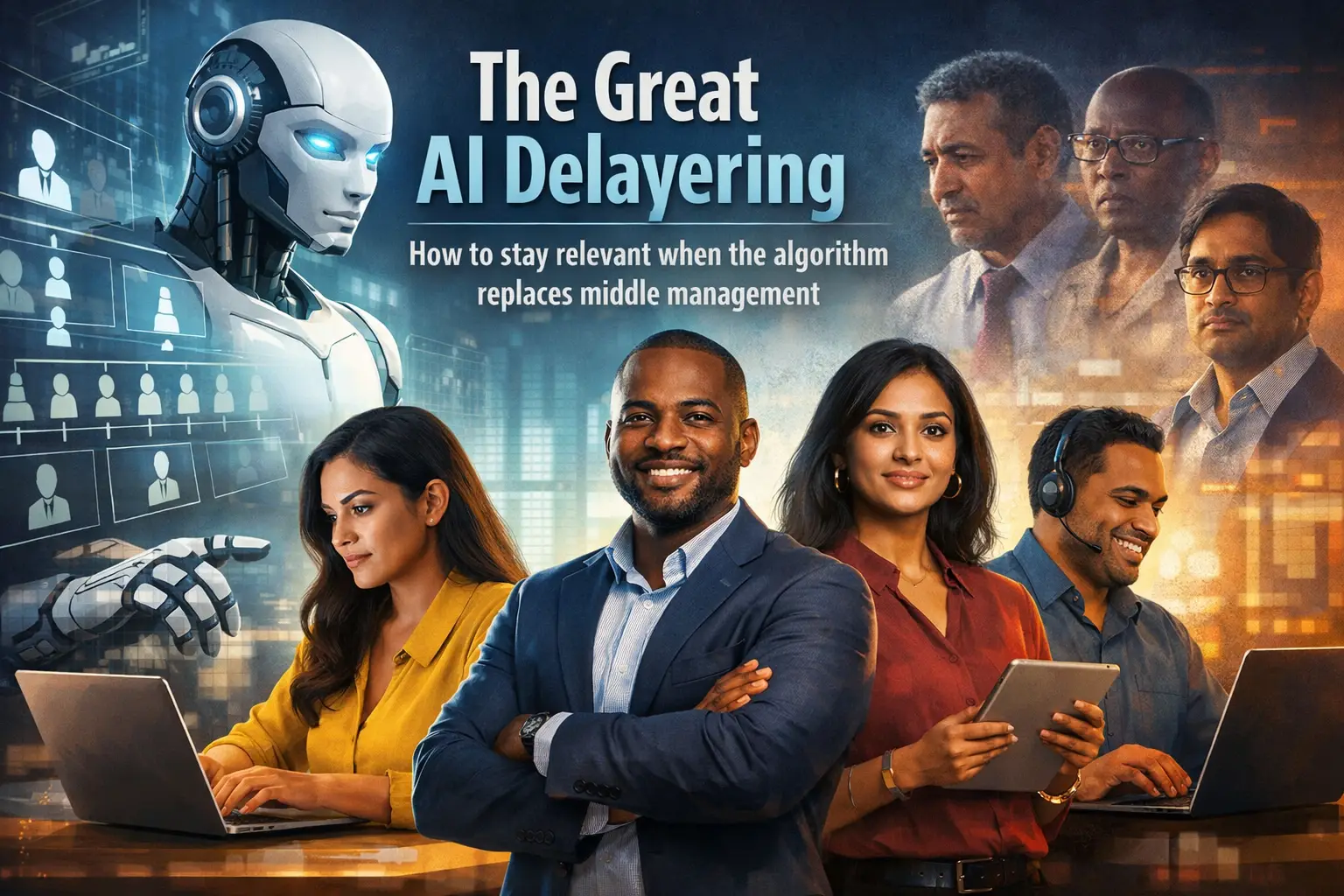
The corporate "layer cake" is melting, and if you’re sitting in the middle, you’re likely feeling the heat.
For decades, middle management was the ultimate safety net: the place where "oversight" and "coordination" were the golden tickets to a six-figure salary and a comfortable career path. You managed the flow of information, you approved the requests, you sat in the status meetings, and you translated the "vision" from the top into "tasks" for the bottom.
But there’s a new foreman on the factory floor, and it doesn’t take lunch breaks or ask for a raise. It’s an algorithm.
We are currently witnessing The Great AI Delayering. This isn't just another buzzword or a minor "restructuring" phase. It is a fundamental purge of the traditional middle-management function. According to Gartner, by 2026, 20% of organizations will have eliminated more than half of their middle management roles. If your job description involves the words "supervise," "coordinate," "report," or "monitor," you aren't just at risk: you’re already being replaced.
The question isn't whether the "Executive in Transition" will survive. The question is: what do you have left to offer when the machine can do your job better, faster, and cheaper?
The Invisible Guillotine: What’s Actually Being Automated?
Let’s get real about what a middle manager actually does on a Tuesday morning. You probably spend 40% of your time on administrative overhead: approving time-off requests, checking project statuses, compiling data for a quarterly report, and making sure everyone is following the standard operating procedures.
Here’s the cold, hard truth: AI is better at all of that.

When an employee needs software approval or a vacation day, an AI-driven decision tree can evaluate team coverage, project deadlines, and budget constraints in milliseconds. It doesn’t need to "check with its boss." When a project is slipping, an AI agent doesn’t wait for the weekly sync to flag the delay; it identifies the bottleneck in real-time and suggests a resource reallocation before you’ve even had your first cup of coffee.
The "Paper-Pusher" is dead. The "Status-Checker" is obsolete. The "Data-Aggregator" is a ghost in the machine. If your value is rooted in being a human router for information, you are the bureaucratic bloat that the algorithm was designed to cut.
The Death of the "Meat Sandwich"
Middle managers have long been described as the "meat in the sandwich": squeezed between the strategic demands of the C-suite and the operational realities of the frontline. In the pre-AI era, being the sandwich meat was a vital role. You were the translator. You were the buffer.
Now? The C-suite can talk directly to the data. They don’t need you to summarize the "vibes" of the team when they have real-time sentiment analysis and productivity metrics at their fingertips. Conversely, the frontline doesn’t need you to explain the company's "North Star" when their AI-integrated task managers are automatically aligning their daily output with organizational goals.
The sandwich is collapsing, and the meat is being squeezed out. To survive, you have to stop being the "buffer" and start being the "bridge."
The Human Moat: Where the Algorithm Fails
If you want to stay relevant, you need to build a "human moat." These are the areas where silicon and code simply cannot compete with biological consciousness. AI is fantastic at answering questions, but it’s terrible at knowing which questions are worth asking. It can optimize a process, but it can’t navigate the messy, ego-driven, political landscape of a high-stakes board meeting.
The "Executive in Transition" must pivot toward three higher-value domains:
1. Orchestration, Not Oversight
The future isn’t about "managing people"; it’s about orchestrating hybrid teams of humans and AI. You shouldn't be the one doing the work or even checking the work. You should be the architect who designs the workflow. This requires a level of technical fluency that most middle managers are currently avoiding. You don't need to know how to code the AI, but you damn sure need to know how to prompt it, how to audit its output, and how to integrate its capabilities into your team’s DNA.
2. Cultural Stewardship and Talent Alchemy
AI can't mentor a junior employee who is going through a personal crisis. It can't sense the brewing resentment in a team after a round of layoffs. It can't "read the room" when a pivot is failing. Your value now lies in your ability to be an HR-hybrid: a mentor, a coach, and a guardian of the company culture. If you aren't spending your time developing your people’s human skills (creativity, empathy, critical thinking), you aren't leading: you’re just taking up space.
3. Navigating Ambiguity and Complexity
AI thrives in "closed systems" where the rules are defined. It fails in "open systems" where the rules are changing, the data is messy, and the goalposts are moving. As an executive, your job is to handle the exceptions. When the algorithm hits a "does not compute" scenario because of a global supply chain crisis or a sudden shift in consumer ethics, that’s when you earn your paycheck. You are the navigator in the storm.

Survival Tactics for the "Executive in Transition"
If you’re feeling the walls close in, it’s time to stop mourning your old job and start building your new one. Here is the blueprint for career survival in the age of delayering:
Step 1: Radical AI Literacy
Stop treating AI as a "tech thing" that the IT department handles. It is a "leadership thing." You need to be the most AI-literate person in the room. This means experimenting with every tool you can find. Use it to draft your emails, analyze your spreadsheets, and brainstorm your strategies. If you aren't using AI to do your current job 50% faster, you’ll never have the time to learn the skills for your next one.
Step 2: Reverse Mentoring
The traditional hierarchy is a liability right now. The 22-year-old intern who grew up with a smartphone in their hand likely understands the potential of generative AI better than the 45-year-old VP. Swallow your pride. Set up "reverse mentoring" sessions. Let the "juniors" teach you how to use the tools. In exchange, give them the one thing they don’t have: your institutional knowledge and political acumen.
Step 3: Build Informal Networks
The org chart is a lie. The real work gets done through informal networks: the relationships, the favors, the coffee chats, and the shared history. AI cannot navigate an informal network. It only understands the formal reporting lines. Deepen your roots in the organization’s "hidden" structure. Be the person who knows who to call when things go sideways. Be the connective tissue that doesn’t appear on a LinkedIn profile.
Step 4: Become a Complexity Specialist
Look for the problems that are too "messy" for a computer. This usually involves high-stakes negotiation, ethical dilemmas, or long-term strategic bets where there is no "historical data" to train a model. Position yourself as the person who handles the "weird" stuff. If it’s predictable, let the AI have it. If it’s chaotic, make it yours.

The New Reality: Leading from the Edge
The "Great AI Delayering" isn't a death sentence for your career, but it is a death sentence for the career as you knew it. The era of the comfortable middle-manager is over. We are entering the era of the Agile Leader.
This transition is painful because it requires us to shed our identity as "the person in charge." You have to move from a position of control to a position of influence. You have to move from being the person who "knows the answer" to the person who can "guide the discovery."
Axis Becoming exists for this exact moment. We aren't here to teach you how to use a spreadsheet; we’re here to help you evolve into the kind of leader that a machine can’t replace. The displacement is happening. The layers are being stripped away. The question is: when the algorithm finishes its work, will there be a leader left standing, or just an empty desk?
Stay relevant. Stay human. Or get out of the way.