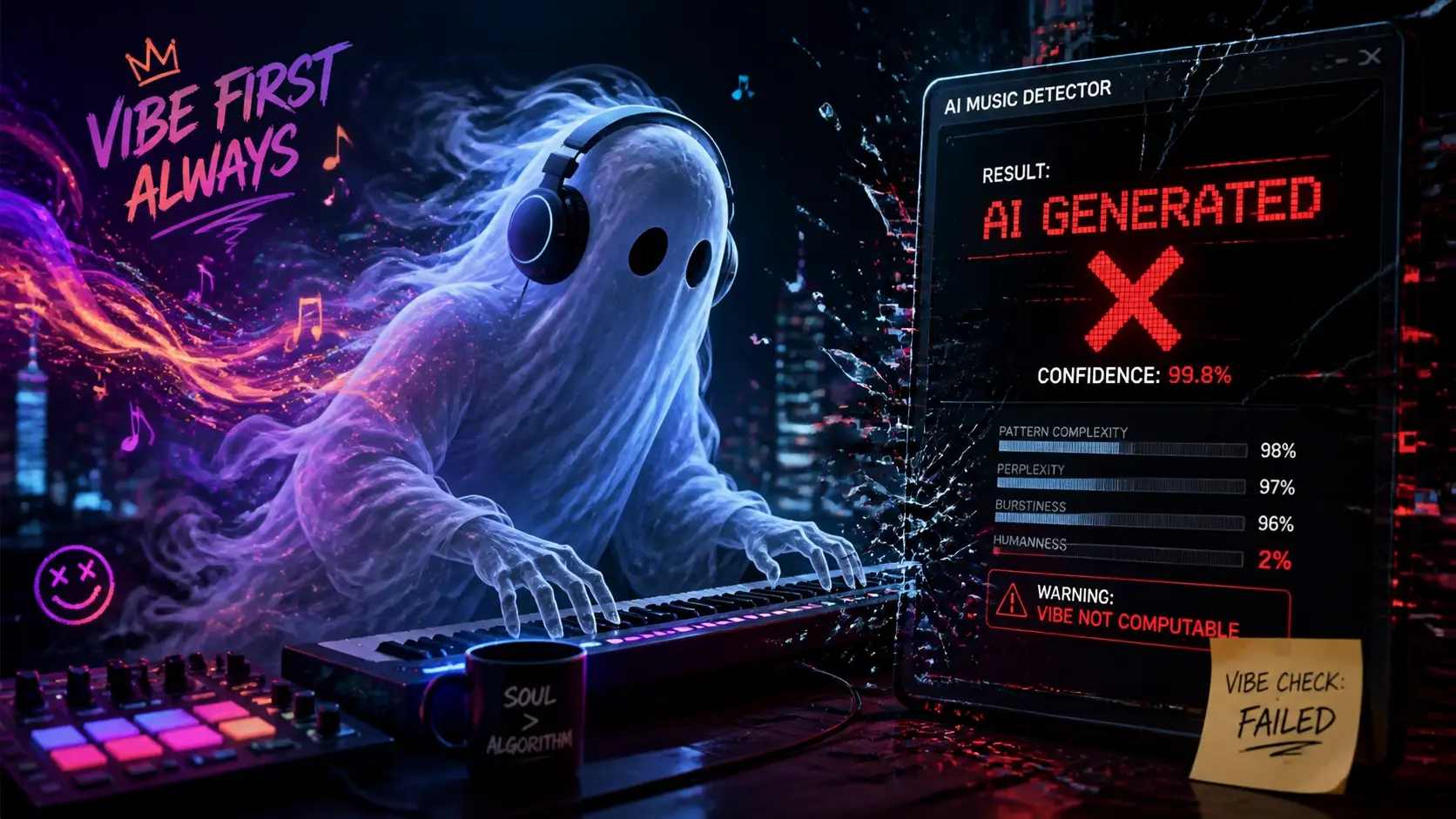
The promise was simple: technology would create, and technology would police. But as we move deeper into 2026, the digital border patrol for music is looking more like a broken turnstile. AI music detectors are supposed to be the final word on authenticity, yet they’re currently failing the most basic vibe check.
From Spotify’s backend to the internal filters of major distributors, the industry is scrambling to label what’s "real." But here’s the reality: the math isn't keeping up with the feeling.
The Digital Telltale: Sand in the High End
If you listen closely to a raw AI-generated track, you’ll hear it. It’s not a melody or a rhythm; it’s a texture. Producers call it "sand." It’s that grainy, digital hiss living in the high frequencies: a byproduct of neural networks trying to reconstruct audio from a compressed latent space.
Human-made music, even when recorded in a bedroom, has a different noise floor. AI music often suffers from "robotic pitch," where the vocal isn't just tuned; it’s mathematically centered in a way that feels sterile. There’s no micro-fluctuation, no lung capacity behind the note.
Then there are the "tails." In a human recording, the reverb of a snare or the decay of a vocal tail follows the laws of physics. In AI generation, these tails often warp. They might end abruptly or morph into a different frequency entirely. It’s a glitch in the simulation that the human ear picks up instantly, even if the brain can’t quite name it.

The Math Problem: Why Detectors Trip
Detectors are currently obsessed with "harmonic distribution." In theory, human instruments produce a predictable series of overtones. AI, however, often gets the math slightly wrong. It generates sounds that look like a piano in a waveform but distribute energy across the frequency spectrum in ways no physical string ever could.
But here’s why the detectors are currently unreliable: post-processing.
A savvy creator doesn't just "bounce" an AI track and upload it. They run it through analog hardware, add saturation, or use stem extraction to pull the "soul" out and re-mix it. When you extract stems from an AI track, you see the "spectral leakage." The ghost of the vocal is still haunting the drum track.
Current detectors struggle with this. If you put a heavy enough master on an AI track, or if you run it through a low-pass filter to hide that "sand" in the high end, the probability score of a detector drops off a cliff. We’re seeing a massive rise in false negatives: AI tracks passing as human: and worse, false positives, where a human producer using a vintage synth gets flagged for being "too perfect."
The Industry Gatekeepers: Who’s Letting the Ghost In?
The landscape of music distribution has become a ideological battlefield.
Spotify and Deezer have been vocal about tagging. They want a clean ecosystem. But the real gatekeeping happens at the distributor level. This is where the tension between DistroKid and Tunecore becomes obvious.
Tunecore has taken a harder line, positioning itself as the guardian of "traditional" artistry. They’ve implemented stricter screening processes to sniff out pure AI generation before it even hits the platforms. They want to preserve the "prestige" of the artist.
DistroKid, on the other hand, operates more like the Wild West. While they don't explicitly advocate for low-quality AI spam, their model is built on volume. This creates a massive loophole. If one distributor blocks you, you just move your "ghost" to another platform that’s less interested in the vibe check and more interested in the subscription fee.

The Uncanny Valley of the Soul
We talk a lot about the "uncanny valley" in visuals, but it exists in audio too. It’s the point where a song is 99% perfect, and that final 1% of perfection makes it feel utterly wrong.
Human music is defined by its mistakes. The drummer who is a millisecond behind the beat creates "swing." The singer whose voice cracks under emotional weight creates "soul." AI doesn't understand the emotional weight; it only understands the statistical probability of a crack occurring.
When AI tries to replicate these "human" elements, it often feels calculated. The "soul" is mapped out on a grid. This is why AI music detectors are failing: they are looking for patterns, but the very essence of human music is the breaking of patterns.
You can train a model on every blues record ever made, but the model won't know why the guitarist stayed on the flat fifth a second too long. It just knows it happened 14% of the time in the training data.

Harmonic Flaws and Spectral Leakage
The most significant technical hurdle for AI music right now is the way it handles complex layers. When a human mixes a track, every instrument occupies its own space. In AI generation, the "instruments" are often inseparable at a fundamental level.
If you try to use a professional AI detector on a track that has undergone "stem extraction," the results are laughable. The software gets confused by the digital artifacts left behind: the "spectral leakage." These detectors are essentially trying to solve a puzzle where the pieces have been melted together.
Until detection software can reliably distinguish between "AI-generated" and "AI-assisted" (like using an AI-based noise reducer on a human vocal), the "vibe check" will remain a human-only privilege.

The Future: An Arms Race with No Finish Line
We are entering a period where the "ghost" will become indistinguishable from the machine. As models learn to hide their own artifacts: masking the sand, varying the pitch, and simulating the swing: the detectors will have to move beyond waveform analysis.
They’ll have to look at metadata, upload patterns, and social proof. Did this artist exist three weeks ago? Do they have a recording history? Or did they just drop 400 perfectly mastered lo-fi beats in a single Tuesday?
The "vibe check" isn't just about the audio anymore; it’s about the context. AI can simulate the sound, but it can't (yet) simulate the journey. For now, the best detector we have is the hair on the back of your neck when a song feels just a little too "calculated."

The machine is trying to find the ghost, but the ghost keeps moving. And in that movement: in that struggle for authenticity: lies the future of what we choose to listen to.
For more deep dives into the intersection of tech and culture, visit monroerodriguez.com.