For decades, the titans of Silicon Valley sat comfortably behind massive fortresses. We called these fortresses moats. If you wanted to compete with Google, you needed a global crawl of the entire internet. If you wanted to challenge Amazon, you needed a logistics network that could reach the moon. If you wanted to fight Microsoft, you needed every office worker on the planet to already be using your operating system. These were not just advantages; they were insurmountable barriers to entry.
Then came the current wave of artificial intelligence.
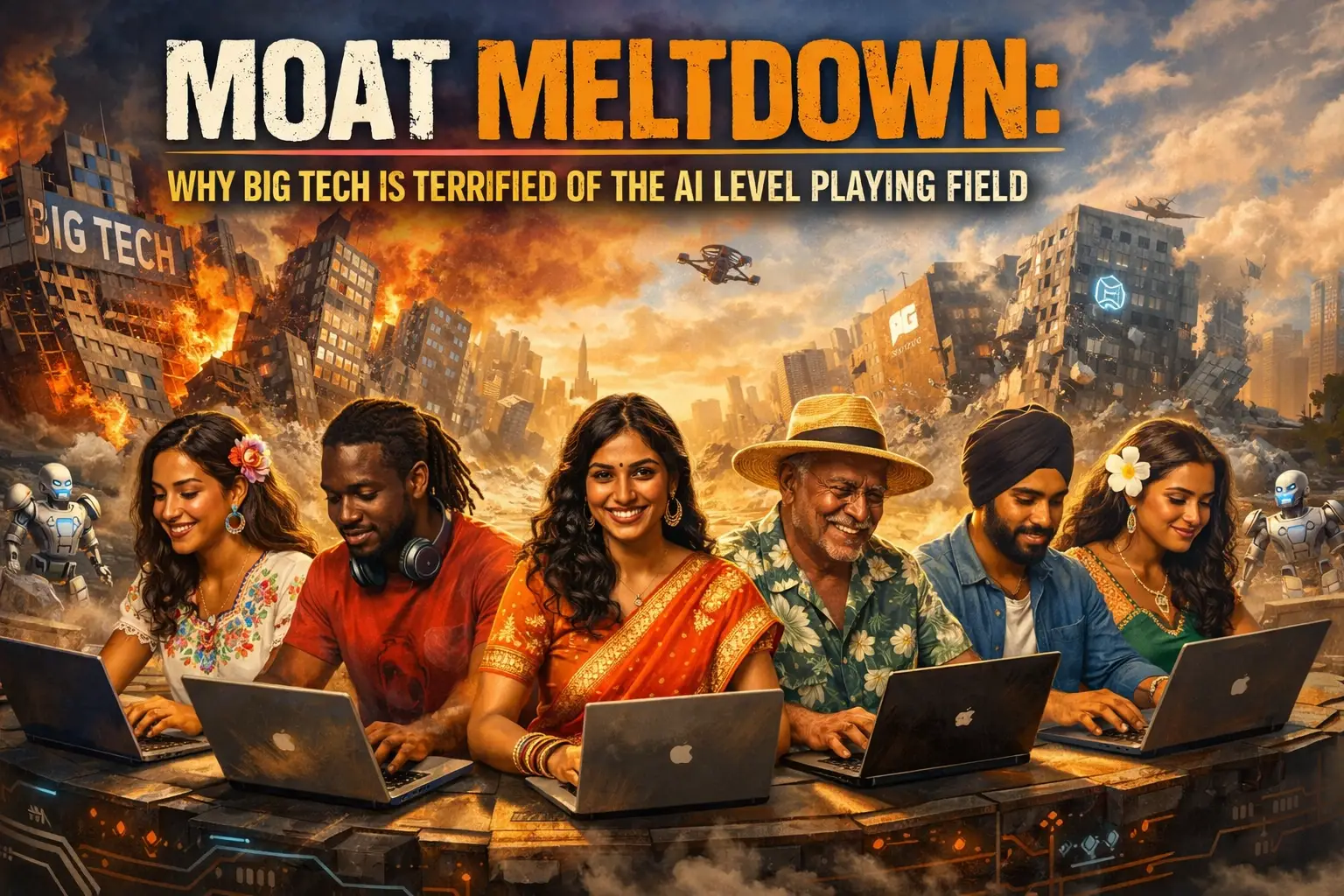
Initially, the narrative was that Big Tech would only get bigger. They had the most data, the most GPUs, and the most money to hire every PhD on the planet. But as we move deeper into 2026, the walls of those fortresses are beginning to crumble. The moats are drying up, and for the first time in a generation, the playing field is leveling out. This is not just a minor market correction. It is a fundamental power shift that favors the small, the fast, and the focused over the big and the bloated.
The Myth of the Proprietary Data Moat
For years, we were told that data is the new oil. The logic followed that since Google and Meta had more data than anyone else, they would naturally build the best AI. It turns out that logic was flawed.
Most of the world's most powerful large language models were trained on the public web. Once you have scraped the entirety of Wikipedia, Reddit, and every digital book in existence, you hit a point of diminishing returns. More data does not necessarily mean a smarter model. In fact, we are seeing that high quality synthetic data : data generated by AI to train other AI : is becoming more valuable than the messy, disorganized human data sitting in private corporate silos.

When the "secret sauce" of your business is public information, your moat is made of sand. Startups can now access massive datasets and use sophisticated filtering techniques to train models that rival the giants. The realization that private data is not the ultimate weapon has sent shockwaves through boardrooms from Mountain View to Redmond. If a small team in Europe or a decentralized group of researchers can produce a model that performs at 95 percent of the capacity of a trillion dollar company’s flagship product, the "data advantage" starts to look more like a data liability.
Panic with a Press Release
If you want to know how scared Big Tech is, just look at their bank accounts. We are witnessing an era of "Panic with a Press Release." Microsoft is funneling tens of billions into OpenAI. Amazon and Google are in a bidding war to fund Anthropic.
On the surface, these look like savvy strategic partnerships. In reality, they are massive hedges. These companies are terrified that their core businesses : search, cloud storage, and enterprise software : are about to be disrupted by the very technology they are funding. They are buying a seat at the table because they can no longer guarantee they own the table.
When a company like Microsoft invests $13 billion into a startup, it is an admission that their internal R&D could not keep up. They are trading cash for relevance. But this creates a paradox. By funding these nimble startups, Big Tech is inadvertently accelerating the destruction of their own traditional moats. They are subsidizing the tools that will eventually allow smaller competitors to bypass the need for massive cloud infrastructure or proprietary ecosystems.
The Open Source Threat: Llama and the End of Secrecy
Nothing has accelerated the moat meltdown quite like the rise of open source AI. When Meta released Llama, it changed the game forever. Suddenly, the most powerful technology on earth was not locked behind a proprietary API. It was available for anyone to download, fine tune, and run on their own hardware.

Models like Llama and Mistral are closing the gap with proprietary giants like GPT-4 in months, not years. We are seeing a global community of developers optimizing these models to run on consumer grade hardware. This is a nightmare scenario for the gatekeepers. If a small business can run a world class AI locally for the cost of a few graphics cards, why would they pay a massive monthly subscription fee to a tech giant?
The open source movement is democratizing intelligence. It is taking the power away from the "Cloud Kings" and putting it back into the hands of the creators. For a startup or an SMB, this is the ultimate opportunity. You no longer need a hundred million dollars to build something groundbreaking. You just need a laptop and a good idea.
The Great Resignation in the AI Lab
For a long time, Big Tech maintained its dominance through "talent lock in." They offered seven figure salaries, free kombucha, and golden handcuffs to the brightest minds in machine learning. If you were a top tier AI researcher, you worked at Google Brain, Meta AI, or Microsoft Research. There was nowhere else to go.
That has changed. The "Great Resignation" has hit the AI world.
Researchers are realizing that they can have more impact (and potentially more wealth) by joining a scrappy startup or founding their own company. The prestige of working for a legacy tech giant is fading. Today's top talent wants to build, not maintain. They want to ship products in weeks, not navigate the endless bureaucracy of a corporate legal department. This brain drain is hollowing out the innovation engines of the giants, leaving them with massive headcount but diminishing creative output.

The Global Wildcard: China and DeepSeek
While Western tech giants are busy suing each other and worrying about quarterly earnings, the landscape is being further disrupted from the East. Companies like DeepSeek and Alibaba are taking a "non-commercial" approach to AI dominance. By releasing powerful models for free or at extreme discounts, they are effectively undercutting the business models of American AI companies.
This global competition is forcing a race to the bottom in terms of pricing. When intelligence becomes a commodity, you cannot charge a premium for it. This is great for users and startups, but it is devastating for companies whose entire valuation is built on the idea of selling AI as a high margin luxury good.
The Level Playing Field: Small is the New Big
The most exciting part of this moat meltdown is what it means for everyone else. We are entering an era where the "size" of a company matters far less than its "speed."
In the old world, Big Tech won because they could outspend and outscale everyone. In the AI world, you win by being agile. A team of three people using AI can now do the work that used to require a department of thirty. They can build digital experiences that are more personal, more responsive, and more innovative than anything coming out of a bloated enterprise.
The barrier to entry has not just been lowered; it has been vaporized. If you are a small business or a founder, this is your moment. The giants are distracted, trying to figure out how to protect their dying moats. They are bogged down by legacy systems, regulatory scrutiny, and the need to protect their existing revenue streams.

You don't have those problems. You can build on top of open source models, leverage the best tools from any provider, and pivot your entire strategy in a weekend. You can focus on solving real problems for real people rather than worrying about shareholder value or cloud compute margins.
The Final Takeaway
The "Moat Meltdown" is a once in a generation event. The structural advantages that allowed a handful of companies to dominate the digital world are dissolving. Data is accessible, talent is mobile, and the technology is becoming open and commoditized.
This isn't just corporate repositioning. It is a fundamental shift in how value is created and captured in the economy. The future belongs to the lean, the clever, and the fast. Big Tech will still exist, but they will no longer be the only game in town. The playing field is finally level, and the game is just getting started. It is time to stop worrying about the giants and start building the future.