We are currently living through one of the greatest magic tricks in the history of the technology industry. Every morning, millions of professionals log into their favorite artificial intelligence platforms, pay their twenty dollar monthly subscription, and feel like they have gained a superpower for the price of a few cups of coffee. It feels like progress. It feels like the future. But if you look behind the curtain, you will find a financial reality that is far more fragile than the polished interfaces suggest.
The current state of the artificial intelligence market is not a sustainable business model. It is a massive, venture capital funded experiment in habit formation. We are being trained to rely on tools that cost significantly more to operate than what we are being charged. This is the subsidy trap, and if your business strategy relies entirely on these current price points, you might be building on a foundation of sand.
The Subsidized Reality of Compute
Right now, the heavy hitters in the industry are burning through billions of dollars every single quarter. While you see a twenty dollar seat on your billing statement, the actual cost of the compute required to process your complex requests can be astronomical. Some industry insiders suggest that for certain high intensity users, the actual cost to the provider could be as high as five thousand dollars in raw compute power over the course of a month.
This is a familiar playbook. We saw it with ride sharing apps and food delivery services. For years, you could get a car across town for five dollars because venture capitalists were paying for half of your ride. The goal was to destroy the competition and make the service a daily necessity. Once the world was hooked, the subsidies vanished, and prices tripled. With artificial intelligence, the gap between the price and the cost is even wider. We are essentially using "subprime" intelligence, and the bill is going to come due.

The Wall of Diminishing Returns
For the last few years, the mantra in the industry has been that bigger is better. More data, more parameters, more GPUs. The assumption was that if we just kept scaling the models, they would eventually reach a point of perfect human reasoning. However, we are starting to see the curve flatten.
We have hit a literal wall with training data. These models have already scraped almost every piece of high quality human knowledge available on the open internet. Every book, every research paper, every public social media post has been fed into the machine. Despite this, a model with three to five trillion parameters still cannot fully replace a senior engineer. It can mimic the patterns of code, but it lacks the deep contextual understanding of business logic. Increasing the size of the model by another factor of ten does not yield a ten times increase in capability. It mostly just increases the electricity bill.
The Model Collapse Threat
There is a growing problem that researchers call model collapse. As the internet becomes flooded with content generated by artificial intelligence, new models are being trained on the output of their predecessors. It is a digital version of the old school photocopy problem. If you make a copy of a copy, the image gets blurrier.
When an artificial intelligence is fed its own digital waste, it begins to lose the nuances of human language and logic. The edges get rounded off. Errors become baked into the foundation. If we continue on this path, the very tools we use to increase productivity could lead to a steady decline in the quality of information available. We are reaching a point where "human made" data will become the most valuable commodity on earth because it is the only thing that keeps the models from descending into gibberish.

The Coming Forty Times Price Hike
If you follow the money, the math leads to a startling conclusion. The venture capital firms that have poured hundreds of billions into these frontier models eventually want a return on their investment. They are not charities. Once the market reaches a point of saturation, or once the funding rounds dry up, the pricing will have to reflect the actual cost of operations.
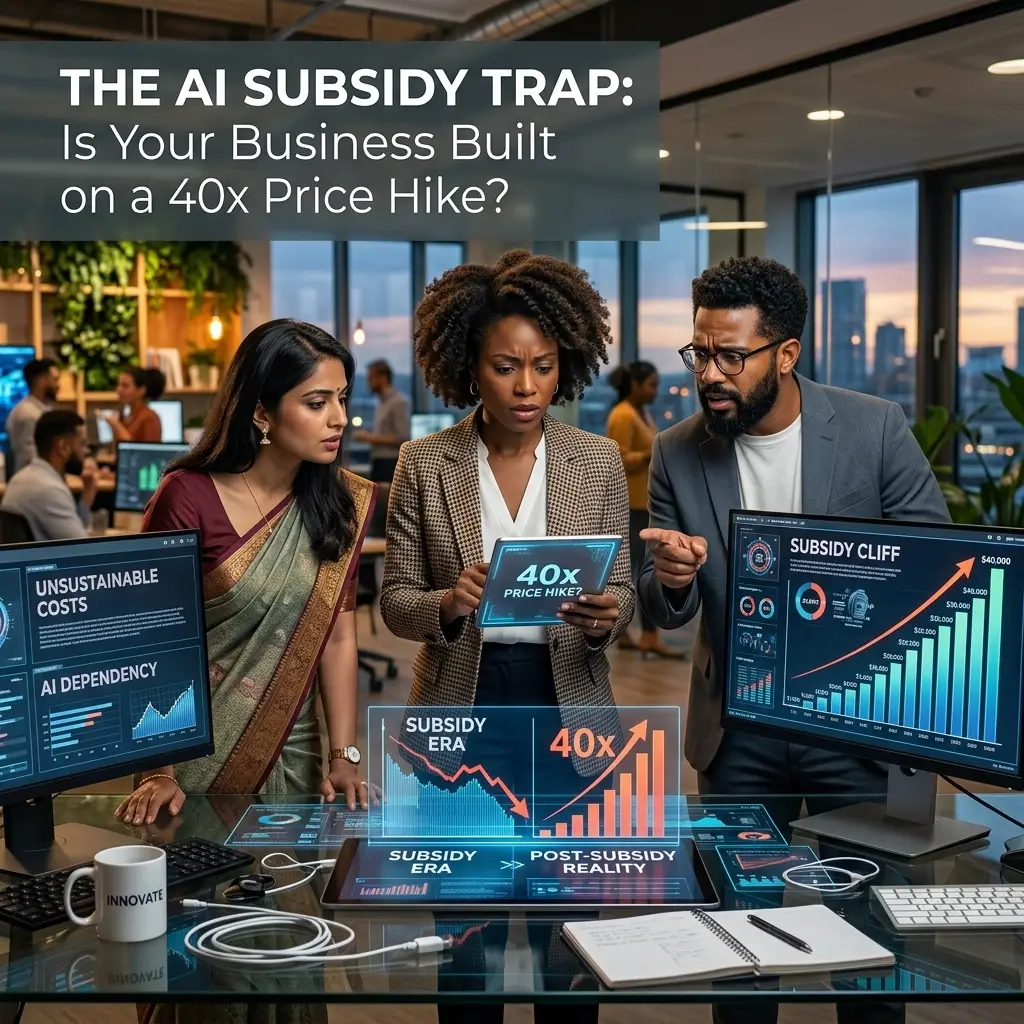
Predictions are circulating that for these companies to recoup five or six years of losses, subscription prices could jump significantly. We are not talking about a five dollar increase. Some analysts suggest that to reach true profitability without subsidies, the cost of top tier access could jump by forty times. Imagine your department budget for software tools suddenly multiplying by forty overnight. If your entire workflow is built on the assumption that "intelligence is cheap," you will find yourself in a very difficult position.
The Rise of the Small and Focused
While the giant frontier models grab all the headlines, a quieter revolution is happening with small, focused models. These are models with under seventy billion parameters that are trained for specific tasks rather than trying to know everything about everything.
These smaller models are the real future of sustainable business integration. They are cheaper to run, they can be hosted locally for better security, and they do not require a massive venture capital subsidy to stay alive. In the software engineering world, a model that only knows how to write clean Python is often more useful than a massive model that can also write poetry about 17th century French history. Moving away from bloated models toward lean, specialized tools is the best way to hedge against the coming price corrections.

Why You Should Not Let Your Skills Dull
The biggest risk of the current artificial intelligence boom is not just the financial trap. it is the cognitive one. There is a generation of developers and creators who are becoming "vibe coders." They prompt the machine, look at the output, and if it looks okay, they ship it. They are losing the ability to debug the logic or understand the underlying architecture.
If the subsidies disappear and the price of high end artificial intelligence becomes prohibitive, the people who have allowed their core skills to atrophy will be left stranded. The most successful professionals in the next decade will be those who use these tools for reference and learning but refuse to let them become a crutch. You should be able to build your product even if the internet goes down or the subscription price hits a thousand dollars a month.
Strategy for a Volatile Market
So, how should a business navigate this? The answer is not to ignore artificial intelligence, but to use it with a healthy dose of skepticism. Do not bake a specific, subsidized API into the very core of your product architecture if you cannot afford for that price to increase.
Focus on building systems that are model agnostic. If one provider hikes their prices or their model quality starts to collapse because of poor training data, you should be able to swap to a different provider or a local model with minimal friction. Treat the current low prices as a gift to accelerate your learning, but do not mistake a temporary subsidy for a permanent shift in the cost of doing business.

The bubble might not pop tomorrow, but the air is certainly starting to hiss out of the tires. We have spent the last few years marveling at what these machines can do. Now, it is time to start asking what they actually cost. By focusing on skill retention and architectural flexibility, you can ensure that your business survives the inevitable day when the venture capital charity ends and the real bill arrives. Keep your tools sharp, your models small, and your eyes wide open. The transition from the era of free compute to the era of sustainable intelligence will be a wake up call for everyone who thought the honeymoon would last forever.