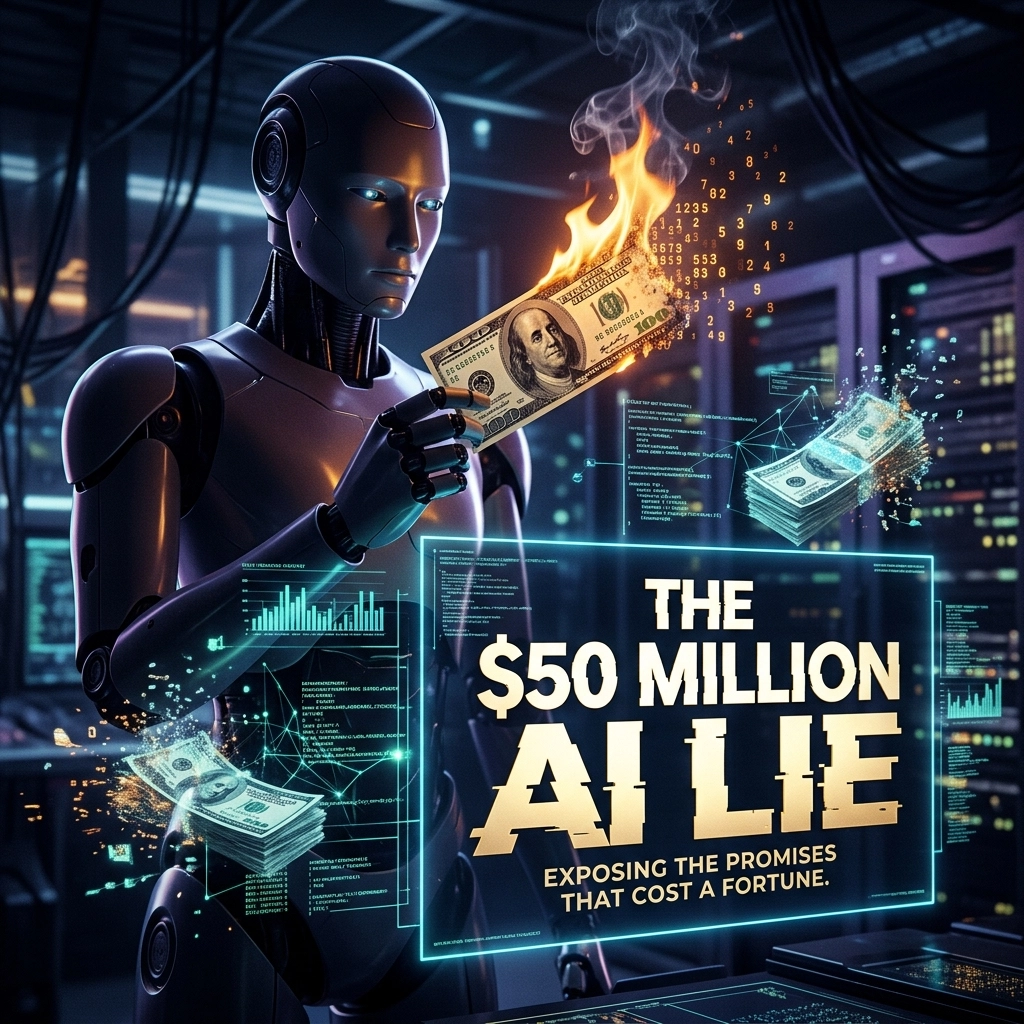
Everyone saw the headline. It was calculated to make you stop scrolling, drop your coffee, and question every life choice you’ve ever made as a creator. "Anonymous AI Prompt Engineer Signs $50 Million Multi-Year Deal with Major Studio."
The internet went into a predictable meltdown. Half the people were cheering for the "democratization of art," while the other half: the ones who actually know how to use a pencil or a camera: felt a cold shiver of existential dread. If a guy typing sentences into a box can pull a $50 million bag, what are we even doing here?
But here’s the thing: the deal wasn't real. Not in the way they wanted you to believe.
When you peel back the layers of these massive "AI artist" contracts, you don’t find a revolutionary new talent. You find a room full of venture capitalists and PR sharks playing a shell game with valuation numbers. It’s a high-stakes gaslighting campaign designed to make you think your soul is obsolete.
It’s time we talk about the $50 million lie and why human creativity is still the only currency that actually matters.
The Anatomy of a PR Stunt
If you follow the money on these viral "mega-deals," the trail usually leads right back to the people who built the software.
Think about it. If you’re an AI platform trying to prove you’re the future of the industry, how do you get legacy studios to buy in? You manufacture a success story. Most of these $50 million figures are "weighted valuations." They aren't handing a creator a check for fifty mil. Instead, it's a mix of software credits, "potential" royalties, and funding for a production company that the tech firm already owns a stake in.
It’s essentially a company funding its own marketing campaign and calling it a "talent acquisition." They aren't buying art; they’re buying a narrative. They want the world to believe that the "human element" is a legacy bug that’s finally been patched out.
By inflating the perceived value of AI-generated work, they create a false market. They want you to feel like you’re falling behind if you aren't fully surrendering your creative process to their algorithms. It’s a classic FOMO play, wrapped in the language of technological progress.

The Gaslighting of the Creative Class
There is a very specific type of gaslighting happening in the design and film world right now. It goes something like this: "You don't need talent anymore. You just need taste."
This is a lie fed to us by people who have never spent ten hours trying to get the lighting right on a single frame. They want to decouple "creative output" from "creative effort." Why? Because effort is expensive. Effort requires humans. And humans need things like health insurance, sleep, and respect.
When a tech CEO stands on a stage and says that AI "levels the playing field," what they’re actually saying is that they want to commoditize your vision until it costs nothing. They want to convince the world that the "soul" of a piece of work is just a collection of statistical probabilities.
But anyone who has ever been moved by a piece of art knows that isn’t true. You can’t automate the "why." You can only automate the "what." AI can give you a thousand versions of a sunset, but it doesn't know why a sunset makes you feel lonely. It doesn’t have a childhood memory of a specific light hitting a specific wall. It has no skin in the game.
Why "Prompt Engineering" Isn't Art
Let’s be real: calling yourself a "master prompt engineer" is like calling yourself a "master jukebox listener." You’re choosing the song, but you didn't write the melody, you didn't play the instruments, and you certainly didn't feel the heartbreak that inspired the lyrics.
The $50 million lie suggests that the prompt is the art. It isn't. The art is the intent. The art is the struggle. The art is the thousand mistakes you made that eventually led to a breakthrough.
When we look at projects that actually move the needle, they aren't the ones that look the most "perfect." They’re the ones that feel the most human. They have grit. They have intentionality. They have that weird, unexplainable spark that happens when a person pushes a medium to its absolute limit.
AI is a tool: a powerful one, sure: but it’s just a brush. And a brush has never signed a $50 million contract on its own.

The Hollow Aesthetic
Have you noticed how all "pure" AI art is starting to look the same? It’s all got that weird, hyper-saturated, plastic sheen. Everything is perfectly centered. Everything is mathematically "correct," and yet, it’s completely forgettable.
This is the "Uncanny Valley" of creativity. Because the AI is trained on a massive average of everything that already exists, its output will always trend toward the mean. It is literally incapable of true subversion. It can’t break the rules because it only exists because of the rules.
Real visionaries break things. They do things that are "wrong" according to the data. They take risks that an algorithm would flag as an error. That’s where the magic happens.
The companies pushing the $50 million narrative don't want you to think about that. They want a world of frictionless, average content that can be produced at scale for pennies. They’re betting that the audience won't notice the missing soul if the pixels are shiny enough.
They’re losing that bet.
Reclaiming the Vision
So, how do we fight back against the lie? We stop playing their game.
We stop measuring our value by how well we can mimic an algorithm and start leaning into the things an algorithm can never do. We lean into our weirdness. We lean into our specific, messy, human experiences.
If you’re a designer or a creator, don't be intimidated by the hype. Use the tools, sure. If an AI can help you iterate faster, let it. But don't let it take the driver's seat. Your value isn't in your ability to generate an image; it’s in your ability to have a vision that is worth generating.
The industry is going to go through a massive correction. The "pure AI" bubble will burst because, eventually, the market will realize that "perfectly average" is just another word for "boring." People are already craving authenticity. They’re looking for the hand of the artist in the work.

The Real Deal
The real $50 million deals aren't happening in the world of prompt engineering. They’re happening where human intuition meets cutting-edge execution. They’re happening in studios where artists use every tool at their disposal: including AI: to bring a unique, soulful vision to life.
We need to stop being impressed by the "how" and start looking at the "who." Who made this? Why did they make it? What are they trying to say? If the answer is "a machine calculated that I would like this," then it isn't art. It’s a product.
Don't let the headlines discourage you. The world doesn't need more "content." It needs more conjuring. It needs more people willing to go into the dark and bring something back that we’ve never seen before.
The $50 million lie was designed to make you feel small. But your ability to feel, to dream, and to create from a place of genuine human experience is the most powerful thing in the room. No algorithm can touch that.
If you’re ready to stop chasing the hype and start building something that actually matters, you’re in the right place. We’re moving past the era of the "perfect prompt" and into the era of the visionary.
Check out our services to see how we’re keeping the human spirit at the center of the design revolution.

Don’t Believe the Hype
Next time you see a headline about a multimillion-dollar AI "artist," take a breath. Look for the strings. Look for the VC backing. Look for the "software credits" hidden in the fine print.
Then, go back to your desk. Pick up your pen, your mouse, or your camera. And make something that a machine would never think of.
That’s where the real money is. That’s where the real future lives.
Stay visionary. Stay human.
Ready to bring your vision to life without losing your soul?
Let’s talk about your next project.